English
- English
- Español
- Português
- русский
- Français
- 日本語
- Deutsch
- tiếng Việt
- Italiano
- Nederlands
- ภาษาไทย
- Polski
- 한국어
- Svenska
- magyar
- Malay
- বাংলা ভাষার
- Dansk
- Suomi
- हिन्दी
- Pilipino
- Türkçe
- Gaeilge
- العربية
- Indonesia
- Norsk
- تمل
- český
- ελληνικά
- український
- Javanese
- فارسی
- தமிழ்
- తెలుగు
- नेपाली
- Burmese
- български
- ລາວ
- Latine
- Қазақша
- Euskal
- Azərbaycan
- Slovenský jazyk
- Македонски
- Lietuvos
- Eesti Keel
- Română
- Slovenski
- मराठी
- Srpski језик

Can showroom‑validated liftable LED promotional counters hold up under repeated cross‑border event cycles?
Earth Display builds multi‑dimensional pre‑qualification workflows for LED rectangle liftable counters, integrating scissor‑mechanism cyclic endurance testing, LED‑strip power‑fluctuation simulation and transit‑condition ageing assessment, identifying showroom‑concealed weaknesses well before units ship for global event‑marketing deployments.
1. Scissor‑lift cyclic endurance evaluation exposes hinge‑pin and pivot‑joint wear risks
Showroom demos only perform limited up‑down adjustment cycles for visitor demonstration. When deployed across dozens of roadshows and exhibition dates, the scissor‑type lifting frame goes through hundreds of height‑modification cycles. Low‑grade pivot pins and thin‑wall hinge connections develop incremental play. Over time, counter tops tilt, height positions cannot lock reliably, or the whole frame produces noticeable rattling noise during customer interactions. Simple static showroom inspection cannot catch slow mechanical‑wear trends. Earth Display subjects finished frame assemblies to thousands‑time lift‑lower cyclic lab simulation. Pivot‑component dimensional thresholds filter out marginal‑fit parts at pre‑production phase, stabilising mechanical‑locking performance for multi‑event repeated‑use scenarios.
2. Variable‑voltage LED‑strip simulation mitigates venue‑power‑related uneven‑glitch failures
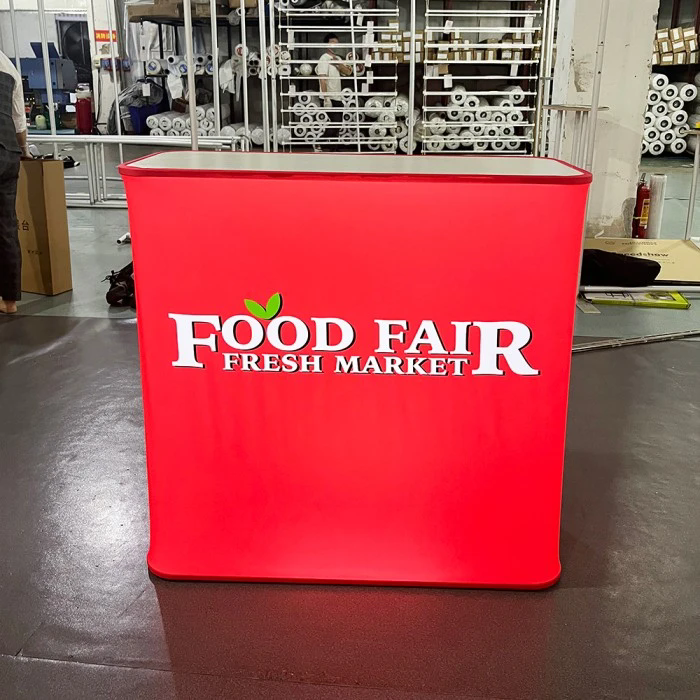
Showroom environments maintain stable, clean mains‑power input for sample counters. Real‑world exhibition halls, pop‑up mall venues and outdoor roadshows frequently deliver fluctuating local supply‑voltage. Poorly matched LED drive circuits suffer partial strip dimming, flickering, or segment‑by‑segment light‑outage. This breaks the uniform back‑lit visual effect critical for brand presentation, even if every LED chip passes static bench‑check. Earth Display carries out variable‑voltage input simulation covering common venue‑supply deviation ranges. Drive‑board parameter tuning ensures consistent luminous performance under unstable power‑source conditions, avoiding embarrassing partial‑illumination breakdowns during live‑event hours.
3. Transit‑simulation ageing uncovers hidden fabric‑skirt and zipper‑seam fatigue damage
Sample fabric‑wraps stay neatly stretched inside showrooms without transportation stress. In cross‑border logistics, counters get folded, squeezed inside carry‑bags, stacked among other booth hardware and subjected to vibration during sea‑and‑truck transit. Inferior stitching and low‑elastic fabric substrates develop micro‑tears along zipper edges and corner seams. The damage stays invisible while the cover remains stretched over the frame; defects only become visible after unfolding on‑site. Earth Display executes vibration‑and‑compression transit‑simulation ageing for complete counter‑and‑fabric‑kit assemblies. Seam‑strength acceptance criteria reduce seam‑rupture probability when kits circulate across multiple international trade‑show destinations.
4. Load‑variation stability testing accounts for uneven real‑world countertop payload distribution
Showroom demos place light‑weight demo props evenly across table‑top surfaces. Actual event‑site conditions bring uneven payload: heavy product samples, laptops, brochure stacks get placed off‑centre toward one table edge. Sub‑optimised base‑plate weight‑distribution and scissor‑frame geometry create tipping‑hazards under off‑centred heavy‑load scenarios, which never appear with well‑balanced showroom‑sample set‑ups. Earth Display conducts offset‑point static‑load stability validation for each counter size variant. Base‑plate counter‑weight matching gets optimised, lowering on‑site tipping‑risk when event‑staff place unevenly‑distributed promotional‑material payloads.
5. Graphic‑compatibility pre‑assessment prevents LED‑back‑light distortion from mis‑specified fabric‑substrates
Many buyers focus only on exterior graphic print quality. They overlook fabric‑substrate light‑transmittance matching with internal LED arrays. Generic substitute fabric materials can create hot‑spot bright zones or dim shadow‑patches after installation, ruining back‑lit brand‑logo rendering. Visual checks on loose flat fabric swatches cannot predict light‑distribution behaviour once stretched tightly around the three‑dimensional counter frame. Earth Display evaluates each selected fabric lot in assembled counter‑state, mapping light‑transmittance uniformity under real‑LED‑illumination. This validates back‑light performance before bulk fabric‑printing commences, avoiding mass‑produced graphic‑covers with uneven luminous‑display defects.
6. Event‑oriented compliance‑and‑spare‑part documentation simplifies global‑venue audit cycles
Major European and North‑American exhibition venues enforce fire‑safety requirements for textile display‑materials plus electrical‑component safety checks. Generic one‑off sample certificates do not satisfy serial‑batch venue‑audit requirements. Without lot‑specific English‑language material‑safety and electrical‑test dossiers, event‑agencies face last‑minute venue‑rejection. Earth‑Display compiles batch‑linked documentation covering fabric flame‑retardant attributes and LED‑driver electrical‑safety data. Supplementary spare‑part reference lists for pivot‑hinges, LED‑strips and zipped‑fabric‑skins accompany each shipment, supporting multi‑year repeated‑event‑deployment maintenance for cross‑border marketing‑agencies.
Previous :
-
Related News
- New Pop Up LED Light Box: Portable, Eye-Catching Backdrop for Global Exhibition Brands
- Why Are Trade Show Tents Essential for Successful Brand Promotion?
- How Does a Pop up Wall Transform Your Event and Marketing Experience?
- What Makes Rectangle Flag the Best Choice for Modern Advertising and Branding?
- Why Choose a Teardrop Flag for Your Business Promotion?
- Why Are Triangle Pop Up Banners Becoming the Most Effective Outdoor Advertising Tool for Events and Promotions
Leave me a message